

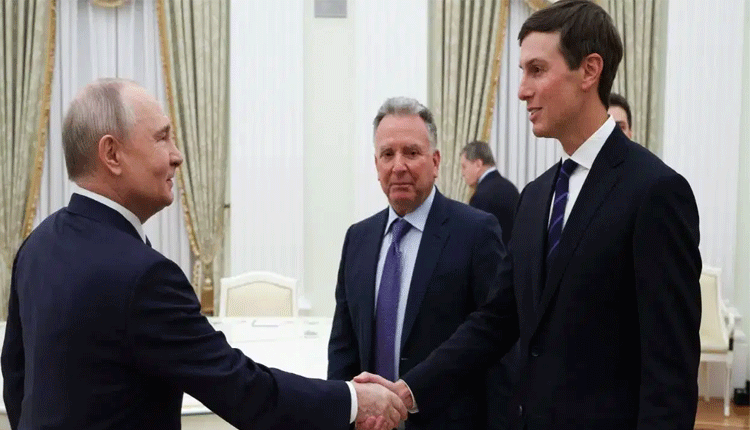
Moscow: In a major development concerning the ongoing conflict in Eastern Europe, Russian President Vladimir Putin has firmly refused to alter his demands to end the Ukraine war. During a marathon four-hour meeting with special envoys of US President Donald Trump, Putin rejected the proposal to relinquish control over occupied territories and vehemently opposed the deployment of foreign peacekeeping forces in Ukraine.

The high-stakes meeting took place on Thursday at the Kremlin in Moscow, where Putin held extensive discussions with Trump’s special envoys, Jared Kushner and Steve Witkoff. According to Putin, allowing foreign peacekeeping troops into Ukraine would merely prolong the war rather than resolve it.
This crucial dialogue in Moscow followed two days of intense negotiations between Russian and Ukrainian representatives in Abu Dhabi. Following their meeting with Putin, the American envoys travelled to the Irish capital, Dublin, to brief Ukrainian President Volodymyr Zelenskyy on the outcomes. Both Zelenskyy and Kushner indicated that representatives from European nations would be included in the next round of talks with Russia. However, Moscow has yet to officially confirm its participation in this new multi-nation diplomatic format.
At the core of the deadlock is Russia’s territorial claim. Moscow has unilaterally declared the Ukrainian regions of Donetsk, Kherson, Luhansk, and Zaporizhzhia as part of its territory, despite not having full military control over them. Ukraine and its Western allies consider this annexation entirely illegal. Nevertheless, Putin has categorically refused to back down from his demand for total control over these four regions.
During the talks, Putin also proposed a brief ceasefire and a humanitarian relief operation in the eastern Ukrainian city of Kostyantynivka, claiming that between 400 and 500 civilians are currently trapped there. While Russia had previously claimed to have captured the city, Ukraine maintains that fierce fighting is still underway. Reacting to the proposal, Dmytro Lytvyn, an advisor to President Zelenskyy, expressed deep scepticism, voicing concerns that Russia might use the guise of a humanitarian operation to covertly transport military equipment to the frontline.
Meanwhile, the conflict’s technological dimensions were also highlighted. President Zelenskyy noted that new restrictions on the Starshield satellite internet service are severely impacting the Ukrainian military’s communication networks. He stressed that these limitations are hindering Ukraine’s ability to intercept Russian drones, leading to an increased loss of soldiers’ lives.