

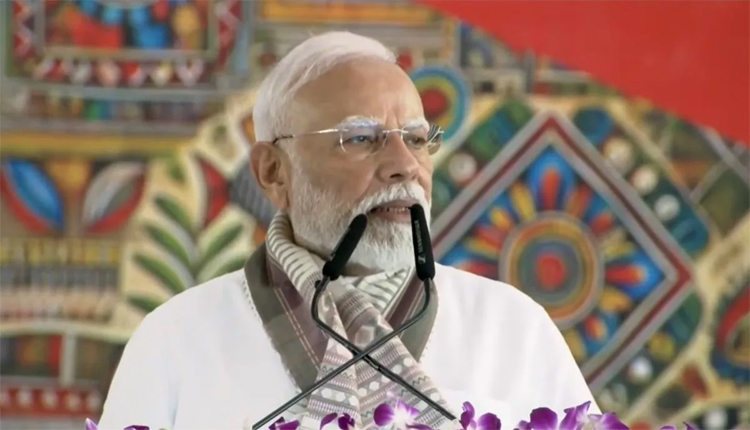
New Delhi: Prime Minister Narendra Modi on Wednesday laid out a comprehensive roadmap for India’s water security, calling for a collaborative “Team India” approach to ensure a sustainable future.

Addressing the valedictory session of the two-day “Departmental Summit on Water” organised by the Ministry of Jal Shakti, PM Modi stressed that water conservation must evolve from a government initiative into a sustained people’s movement (Jan Bhagidari).
“Water security is vital for India and for our planet. It calls for innovative ideas, technology and above all, Jan Bhagidari,” the Prime Minister later shared in a post on the social media platform X.
During the summit, which brought together ministers and senior officials from various States and Union Territories, the Prime Minister emphasised that such policy deliberations should not be treated as a “one-time exercise.” Instead, they must function as an ongoing mechanism for collective action and continuous review. To foster community involvement, he proposed the initiation of “Jal Utsavs” (water festivals) to deepen public awareness regarding conservation.
A significant highlight of PM Modi’s address was his push for modern technological integration in water management. He advocated for the deployment of artificial intelligence (AI) to enhance data collection, analysis, and overall water governance across a uniform platform. By adopting water-saving technologies and exposing Indian stakeholders to global best practices, the country can scale up highly efficient solutions, he noted.
Addressing the mounting pressures of rapid urbanization, PM Modi called upon Urban Local Bodies to proactively organize local Chintan Shivirs (brainstorming sessions) to prepare for future population growth and water requirements. He also proposed structured inter-state study visits involving officials, public representatives, and farmers, ensuring that successful water-management interventions in one state can be seamlessly replicated in another.
Furthermore, the Prime Minister highlighted the critical need for anticipatory planning. He urged stakeholders to move beyond merely reacting to water shortages and instead proactively plan to utilize treated water for agricultural and industrial purposes. He advised making the de-silting of water bodies a regular practice governed by clear standard operating procedures, while also emphasizing rigorous monsoon preparedness and dam safety.
Drawing from his past experience as the Chief Minister of Gujarat, PM Modi reminded the gathering that with systematic planning and commitment, the challenge of water scarcity can be successfully transformed into an opportunity.
Comments are closed.