

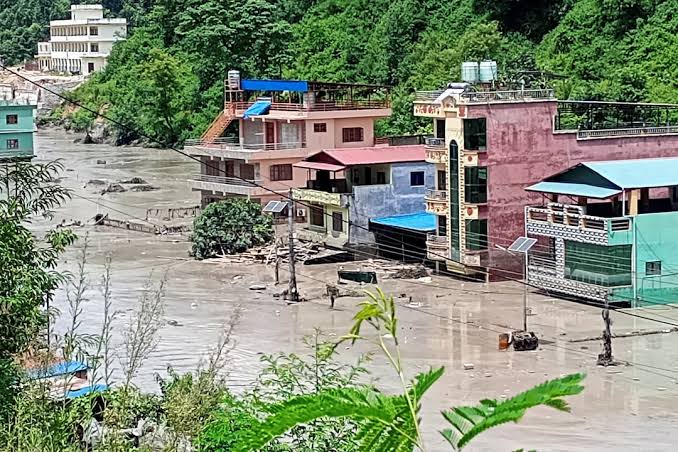
Kathamandu: A week after devastating glacial flash floods battered Nepal, a colossal humanitarian crisis is unfolding as nearly 1,000 workers remain trapped inside the debris-choked tunnels of various hydropower projects. While rescue and relief operations are in full swing, navigating the treacherous, mud-filled terrain has proven to be a monumental challenge for disaster response teams.

According to local reports, the catastrophic floods have severely damaged approximately 12 hydropower projects situated along the region’s riverbanks. The most critical focus remains on six major tunnels, including those at Upper Trishuli, Upper Trishuli-3A, Upper Trishuli-3B, Chilime, Langtang Khola, and Rasuwagadhi. Official estimates suggest that at least 933 employees are missing and feared trapped underground. Project-specific data indicates 122 workers are missing at Upper Trishuli-3B, 93 at Rasuwagadhi, 42 at Upper Trishuli-3A, and 41 at Langtang Khola.
Rescuers are currently facing a multifaceted nightmare. The tunnel entrances are completely blocked by massive boulders, thick mud, and floodwater. Furthermore, the destruction of approach roads and bridges has severely hindered the transport of heavy excavators, pumps, and drilling machines to the remote sites.
Authorities have warned against hasty mechanical excavation, as the surrounding rock formations have been rendered highly unstable. “If digging is initiated without proper assessment, the fragile rocks could collapse entirely, endangering both the trapped workers and the rescue teams,” disaster management teams noted. At the Upper Trishuli-3A site, rescuers managed to reach the upper section of the tunnel to pump in fresh air, but subsequent drilling efforts yielded no response from within.
Addressing the nation’s parliament, Nepal’s Prime Minister Balendra Shah highlighted the deep complexities of the operation. He emphasized the urgent need for specialized tunnel rescue experts and advanced machinery, confirming that Nepal has formally requested assistance from neighboring countries.
Currently, joint teams of Indian and Nepali rescue personnel are spearheading operations in the Chilime and Langtang sectors. In Langtang, rescue workers have successfully penetrated up to 185 metres into the tunnel, though structural instability continues to slow their progress. First, the teams must pump out accumulated floodwater and wait for the ground to dry slightly to safely operate heavy machinery.
Despite the grim circumstances, a sliver of hope remains. Authorities believe that workers in certain tunnels, particularly those with known air pockets and stored food supplies, might still be alive, making every passing minute crucial in this desperate race against time.
Comments are closed.