

New Delhi: In a major push to strengthen India’s transportation infrastructure and improve connectivity, the Cabinet Committee on Economic Affairs (CCEA), chaired by Prime Minister Narendra Modi, has greenlit three critical multi-tracking railway projects. With a substantial financial outlay of approximately Rs 10,783 crore, the expansion aims to significantly reduce congestion and enhance freight movement across several states.

The ambitious initiatives, scheduled for completion by the 2029-30 fiscal year, will span across West Bengal, Jharkhand, Odisha, Madhya Pradesh, and Chhattisgarh. According to official estimates, these projects will add around 656 kilometres of additional track to the existing Indian Railways network.
The three newly sanctioned projects are primarily focused on laying third and fourth lines on heavily congested routes. These include the Kharagpur-Jharsuguda (Bagdehi) fourth line, the Katni-Pendra Road fourth line, and the Bilaspur (Uslapur)-Pendra Road third line.
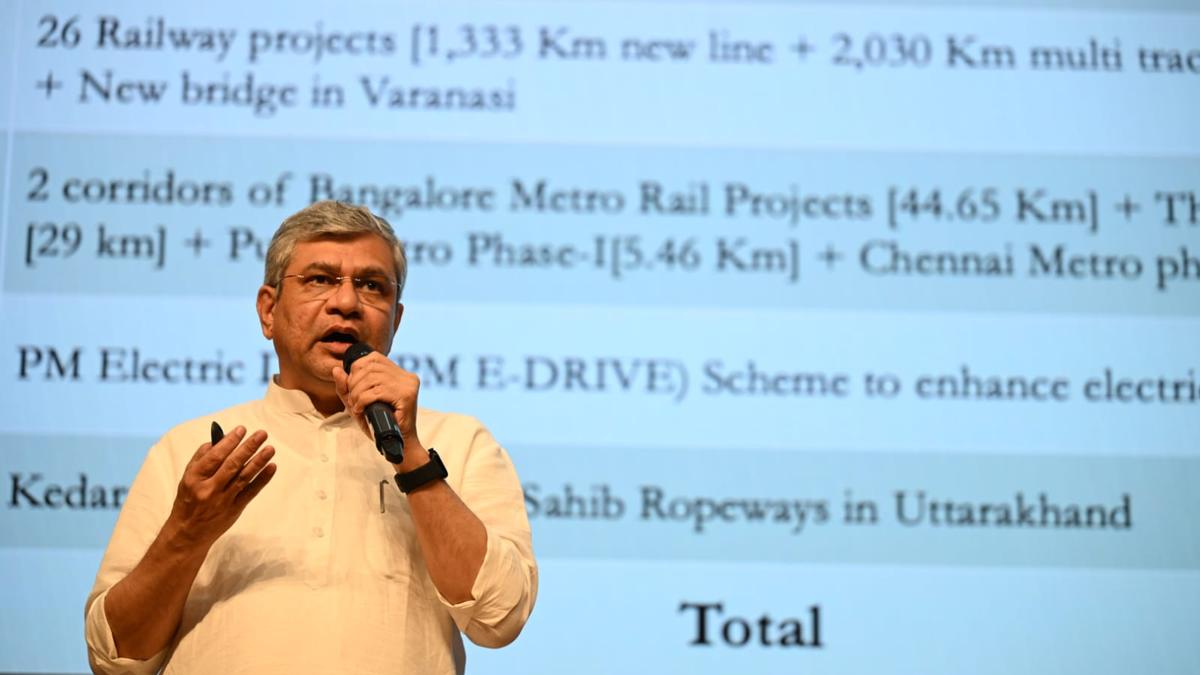
Briefing the media on the cabinet’s decision, Union Railway Minister Ashwini Vaishnaw highlighted the strategic importance of upgrading high-density networks. “If we look at the most important railway corridors—the 11,000 km long, 7 high-density corridors—quadrupling and 4-lining of these corridors are underway. They are going to handle massive traffic in the coming times,” Vaishnaw stated. He noted that these major routes connect Delhi to Mumbai, Mumbai to Chennai, Chennai to Kolkata, and Kolkata to Mumbai, forming the Golden Quadrilateral. “Almost 5,000 km of work is already sanctioned or underway, and another 4,000 km is in the final approval process,” he added.
Developed under the PM Gati Shakti National Master Plan, the projects aim to foster multi-modal connectivity and streamline the country’s logistics framework. They are expected to dramatically improve connectivity for approximately 4,790 villages across 14 districts, directly benefiting a population of nearly 56 lakh.
Additionally, the expansion will provide easier access to prominent religious and tourist destinations, including the Taratarini Temple, the ancient Sri Kshetra Jagannath Temple near Jharsuguda, Bandhavgarh Tiger Reserve, and Amarkantak Temple.
Crucially, the new rail corridors are projected to enhance freight carrying capacity by an estimated 2.7 crore tonnes annually, facilitating the swift movement of essential industrial commodities like coal, cement, iron, and steel.
Shifting freight transport from roads to railways is also expected to yield substantial environmental benefits. The government estimates that the projects will lead to a reduction in oil imports by 12 crore litres and cut down carbon dioxide emissions by 62 crore kilograms—an ecological impact equivalent to planting approximately 2.48 crore trees.
Comments are closed.