

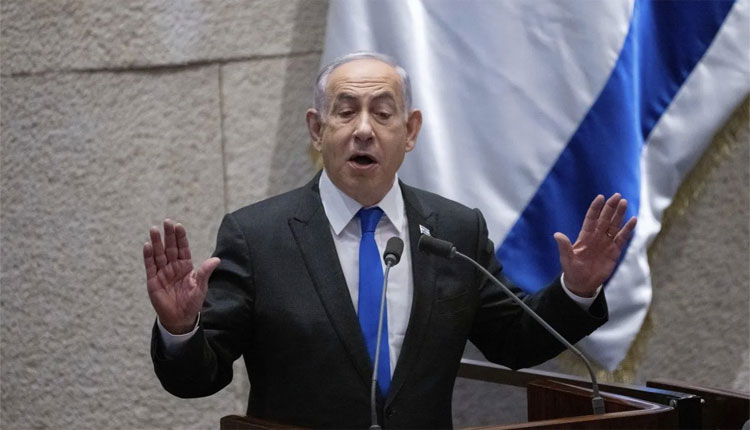
Jerusalem: Following the closely contested 2026 Israeli parliamentary elections, Prime Minister Benjamin Netanyahu is facing a formidable political challenge. Former military chief Gadi Eisenkot has secured the backing of a majority of lawmakers, deepening the suspense over the formation of the next government.

According to early consultations held by President Isaac Herzog, Eisenkot received endorsements from 67 members of the 120-seat Knesset, comfortably crossing the 61-seat threshold required to stake a claim. In stark contrast, Netanyahu’s support shrank to just 46 lawmakers. Although Netanyahu’s Likud party emerged as the single largest entity with 27 seats, his broader religious-nationalist coalition could only muster 53 seats, leaving his bloc well short of a clear majority.
The political arithmetic was significantly upended by two major developments. First, Israel’s Arab-led political factions, which collectively won 19 seats, decided to throw their weight behind Eisenkot. While both Netanyahu and Eisenkot have historically hesitated to form coalitions heavily reliant on Arab parties, this unexpected backing has heavily boosted Eisenkot’s mandate. Secondly, Netanyahu suffered a severe strategic blow when his long-time traditional ally, the United Torah Judaism (UTJ) party, abstained from recommending any candidate during discussions with the President. This refusal to endorse the incumbent Prime Minister drastically reduced the right-wing bloc’s numbers.
Despite the clear numerical advantage for Eisenkot, the path to a stable coalition remains highly complex due to deep ideological divides among his diverse backers. President Herzog has concluded his initial discussions with political representatives and is expected to officially nominate a candidate on Sunday. Commenting on the ongoing political deadlock, Herzog acknowledged that while the numbers appear straightforward on paper, internal party differences make the final decision incredibly challenging.
As per Israeli law, once nominated by the President, the chosen leader will have a standard 28 days to forge a governing coalition, with a possible 14-day extension if required. If no candidate succeeds in establishing a government, the nation could be forced into yet another round of snap elections. Until a new government is officially sworn in, Netanyahu will continue to serve as the caretaker Prime Minister.