

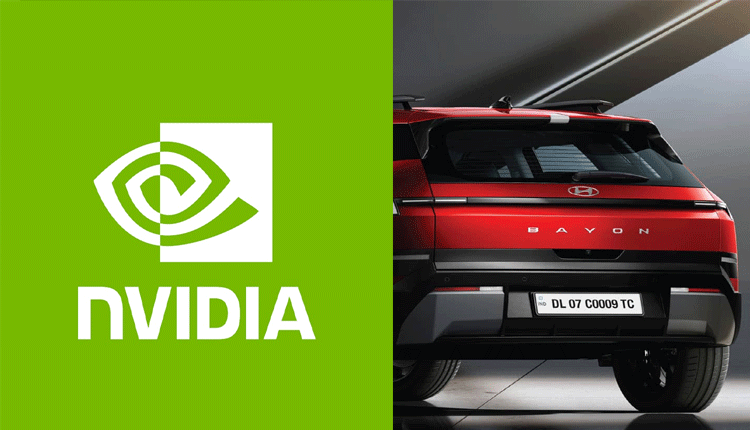
New Delhi: Setting a new benchmark in India’s automotive space, the recently launched Hyundai Bayon is grabbing headlines for its advanced technological integrations. Positioned not just as an SUV but as a smart vehicle, the Bayon is one of the initial major cars in the country to feature a Connected Car Navigation Cockpit (ccNC) system driven by Nvidia’s technology.

At the heart of the Bayon’s digital experience is a dual 12.3-inch curved screen setup powered by Nvidia. It boasts a generative AI voice assistant enhanced by Perplexity and SoundHound AI, allowing drivers to execute over 500 commands across multiple languages. Additionally, the system supports Hyundai Bluelink with over 70 connected features and enables Over-the-Air (OTA) updates for up to 19 controllers, reducing the need for frequent visits to service centres.
The integration of Nvidia’s platform promises a smartphone-like experience on wheels. Users can expect faster system responses, superior graphics and animations, improved voice command comprehension, and the flexibility to seamlessly add new connected services in the future.
However, the growing reliance on external tech giants like Nvidia raises critical questions about long-term vulnerabilities. Traditionally known for gaming graphics cards and computer chips, Nvidia has expanded its footprint in the auto industry amidst the AI boom. While there is no immediate issue for Bayon owners, the broader automotive industry’s shift towards software-defined vehicles means companies are increasingly dependent on third-party providers for chips, AI, and cloud services.
Experts note that any future disruptions in chip supply, changes in AI platforms, or new government regulations could directly impact the functionality of these digital features. This concern is amplified by recent leadership changes at Nvidia, including the resignation of CEO Jensen Huang amid controversies.
The challenge of external software dependence is not unique to Hyundai. Global luxury brands, including Mercedes-Benz, Jaguar Land Rover (JLR), and Volvo, are also embedding Nvidia’s technology in their fleets. As the industry evolves, balancing this cutting-edge technology with supply chain resilience will be crucial for automakers.