

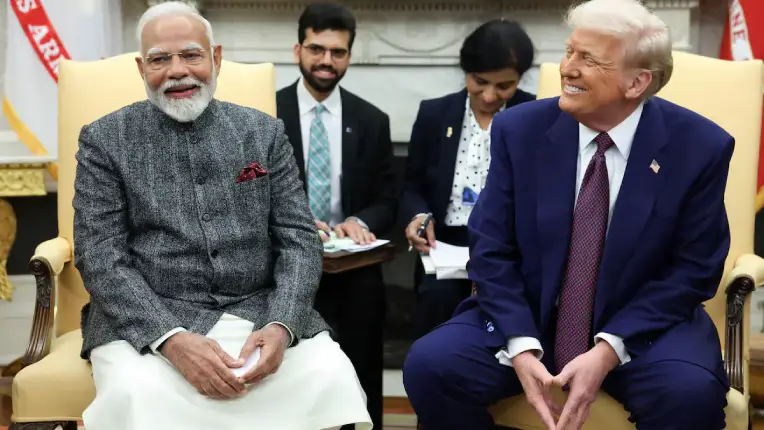
New Delhi: As Donald Trump marks the completion of his first year in his second stint as US President, India’s diplomatic landscape finds itself at a curious crossroads.
Prime Minister Narendra Modi, often hailed as a close ally of the maverick Republican leader, has nurtured a personal bonhomie that dates back to Trump’s first term. Yet, beneath the warm handshakes and grand rallies like the ‘Howdy Modi’ event in 2019 and ‘Namaste Trump’ in 2020, New Delhi is grappling with a slew of challenges that test the resilience of Indo-US ties. Which is why, it is important to analyse the strain on India’s strategic interests, despite the ongoing friendship between Modi and Trump.
The past year has seen Trump’s ‘America First’ agenda resurface with renewed vigour, impacting global trade dynamics in ways that hit India hard. High on the list is the imposition of fresh tariffs on imports, aimed at protecting US industries. Indian exports, particularly in sectors like pharmaceuticals, textiles, and IT services, have felt the pinch. Data from the Ministry of Commerce indicates a dip of nearly 8% in bilateral trade volumes in the last quarter of 2025, with steel and aluminium tariffs hitting margins for Indian firms. “While Modi’s personal rapport with Trump has opened doors for high-level dialogues, it hasn’t shielded us from protectionist policies,” says Dr Arvind Gupta, a former diplomat and fellow at the Vivekananda International Foundation. “India must diversify its markets to mitigate these risks.”
Immigration policies under Trump 2.0 have emerged as another thorn. The tightening of H-1B visa norms, including higher wage thresholds and stricter scrutiny, has disrupted the flow of Indian talent to Silicon Valley. Thousands of Indian professionals, who form the backbone of the US tech industry, face uncertainty.
A report by the Confederation of Indian Industry (CII) estimates that over 50,000 visa applications from Indians were rejected or delayed in 2025 alone, leading to a talent drain back home.
This situation comes at a time when India is pushing its ‘Make in India’ initiative to attract global investments. PM Modi’s charm offensive — as evident in his congratulatory call to Trump post-election and subsequent virtual summits – has yielded some concessions, like expedited processing for select categories, but critics argue it’s not enough. “Friendship is fine, but visas are vital,” quips a Mumbai-based IT entrepreneur, highlighting the ground-level frustrations.
On the geopolitical front, Trump’s unpredictable foreign policy has presented India with unexpected challenges. While both leaders share a hawkish view on China, with Trump ramping up Quad alliances involving India, the US withdrawal from certain multilateral forums has left New Delhi exposed. Trump’s scepticism towards climate accords, for instance, echoes his first-term exit from the Paris Agreement, complicating India’s green energy ambitions amid rising global temperatures. Moreover, his overtures towards Russia to end the Ukraine conflict have clashed with India’s neutral stance, potentially straining energy supplies from Moscow. “Modi’s friendship with Trump buys us influence in Washington, but it doesn’t insulate us from broader US isolationism,” notes foreign policy analyst C Raja Mohan in a recent op-ed.
Despite these hurdles, there are silver linings. Defence cooperation has flourished, with deals like the acquisition of advanced drones and joint military exercises scaling new heights. The personal chemistry between Modi and Trump – often likened to a bromance – has facilitated behind-the-scenes negotiations, and averted potential crises. Yet, as India navigates its aspirations to become a $5 trillion economy by 2027, the challenges underscore a key lesson: friendships in international politics are no substitute for robust, interest-based diplomacy.
As Trump’s second term unfolds, New Delhi will need to leverage Modi’s rapport while hedging against policy volatilities. The coming year could define whether this alliance evolves into a strategic bulwark or remains a tale of unfulfilled potential.
Comments are closed.