

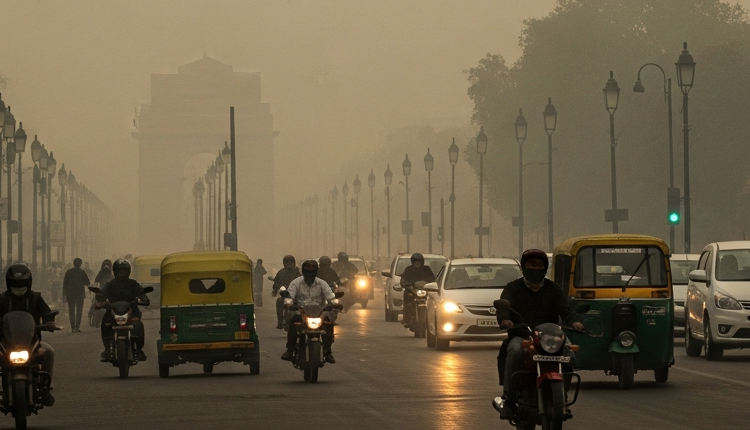
New Delhi: Brushing aside constant global finger-pointing over Delhi’s toxic winter smog, the Centre told Parliament on Thursday that India does not blindly follow WHO air-quality guidelines and instead sets its own National Ambient Air Quality Standards (NAAQS), “keeping in mind the country’s unique socio-economic conditions, technical feasibility, and scientific realities.”
In a written reply tabled in Lok Sabha, Minister of State for Environment Ashwini Kumar Choubey asserted that the WHO’s 2021 guidelines are “aspirational” and not legally binding on any nation. “India has progressively tightened its standards. The current NAAQS for PM2.5 (annual average 40 µg/m³) and PM10 (60 µg/m³) are based on extensive domestic studies and are reviewed every five years,” he stated.
The minister highlighted that since 2009, India has made its norms five times stricter for key pollutants and introduced separate standards for PM2.5 in 2013 — something that didn’t exist earlier. He also listed aggressive steps like advancing BS-VI fuel norms to 2020, banning pet coke in NCR, launching the National Clean Air Programme (NCAP) covering 131 cities, and imposing Graded Response Action Plan (GRAP) restrictions.
Opposition MPs, however, accused the NDA government of “conveniently hiding behind technicalities” while Delhi continued to choke, with AQI regularly crossing 400. They questioned why India cannot adopt the WHO’s safer limit of 5 µg/m³ for PM2.5, especially since countries like Bhutan and Australia have moved closer to that standard.
As stubble burning and firecracker smoke engulf North India once again, the reply has reignited the debate: should a developing nation prioritise public health over economic constraints, or is the government’s “Bharat-first” standard the pragmatic way forward?
Comments are closed.