

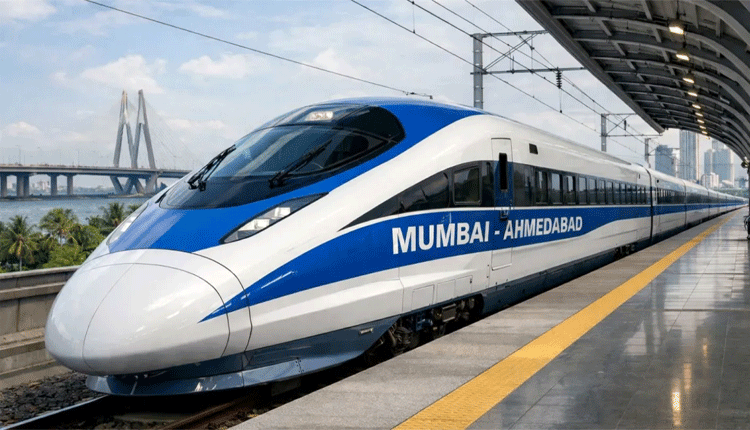
New Delhi: In a major boost to India’s infrastructure goals, Union Railway Minister Ashwini Vaishnaw has announced that the country’s first bullet train is set to be flagged off on August 15, 2027. The high-speed rail, which aims to revolutionize travel between the economic hubs of Mumbai and Ahmedabad, will initially begin operations on the Surat-Bilimora section.

The Minister confirmed that nearly 80 percent of the work on the ambitious 508-kilometer corridor has already been completed. Construction is currently proceeding at a rapid pace to ensure that the project meets its upcoming deadlines. The launch will follow a phased approach, allowing certain sections to become operational even before the entire corridor is fully linked.
According to the roadmap shared by the Ministry of Railways, the Surat-Bilimora stretch will be the first to witness the bullet train in action during the Independence Day celebrations in 2027. Following this, the project will expand in the following sequence:
- Phase 2: Vapi to Surat
- Phase 3: Vapi to Ahmedabad
- Phase 4: Ahmedabad to Thane
- Final Phase: Completion of the Thane-Mumbai link, providing seamless connectivity across the entire route.
The Mumbai-Ahmedabad High-Speed Rail (MAHSR) project is expected to significantly slash travel time between the two cities, while also introducing cutting-edge Japanese Shinkansen technology to the Indian railway network. Beyond speed, the project is envisioned as a catalyst for regional economic growth along the corridor.
While the Mumbai-Ahmedabad line remains the priority, Minister Vaishnaw also detailed long-term plans to expand the high-speed network across India. The government has proposed a series of new corridors, with a particular focus on Southern India. Three major routes centered around Hyderabad are currently under consideration: Pune-Hyderabad, Hyderabad-Chennai, and Hyderabad-Bengaluru.
Additionally, the Ministry is exploring seven other proposed bullet train corridors, including the Delhi-Varanasi and Mumbai-Pune routes. These projects aim to connect 20 major Indian cities, drastically reducing inter-city travel times and modernizing the nation’s transportation landscape for the next generation.
Comments are closed.