

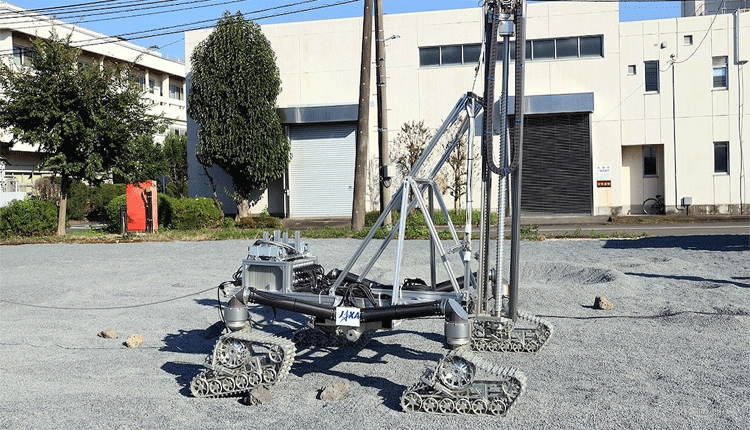
Tokyo: The Japan Aerospace Exploration Agency (JAXA) has showcased the prototype of the rover developed for the Lunar Polar Exploration (LUPEX) mission, also designated as Chandrayaan-5, marking a significant milestone in India-Japan space cooperation.

The demonstration took place at JAXA’s Chofu Aerospace Center in Tokyo, where scientists displayed the 350-kilogram vehicle navigating simulated lunar terrain. Departing from conventional wheeled configurations, the rover is equipped with crawler track belts engineered to negotiate the loose regolith and jagged topography characteristic of the Moon’s polar landscape.
LUPEX is an ambitious joint expedition where JAXA is developing the rover, while the Indian Space Research Organisation (ISRO) is designing and providing the lander module. The mission also incorporates scientific payloads contributed by the US space agency NASA and the European Space Agency (ESA).
Targeted for launch in 2028 aboard Japan’s heavy-lift H3 rocket from the Tanegashima Space Center, the combined mission spacecraft will weigh approximately 6.5 tonnes at lift-off. The baseline operational life on the lunar surface is set at three and a half months, with the potential to extend up to a year if environmental conditions permit.
Unlike earlier missions focused primarily on surface photography and panoramic surveying, Chandrayaan-5 will conduct direct subsurface investigations. The rover is outfitted with seven scientific instruments and a dedicated drilling mechanism capable of excavating samples up to 1.5 meters beneath the surface.
According to JAXA, the mission will map landing sites to pinpoint viable locations for drilling and scientific measurements. Key payloads include ground-penetrating radar to evaluate subsurface strata and a neutron spectrometer to detect hydrogen signals, which serve as critical indicators of water molecules or ice deposits.
Scientists consider the lunar south pole an invaluable testing ground because its permanently shadowed craters have shielded volatile elements from solar radiation for billions of years. Confirming the precise volume, depth, and chemical state of water-ice is seen as crucial for long-term space exploration. If harvested successfully, lunar water could provide drinking supplies for astronauts and be split into hydrogen and oxygen to manufacture rocket propellants and breathable air, drastically reducing the logistical payload required from Earth.