

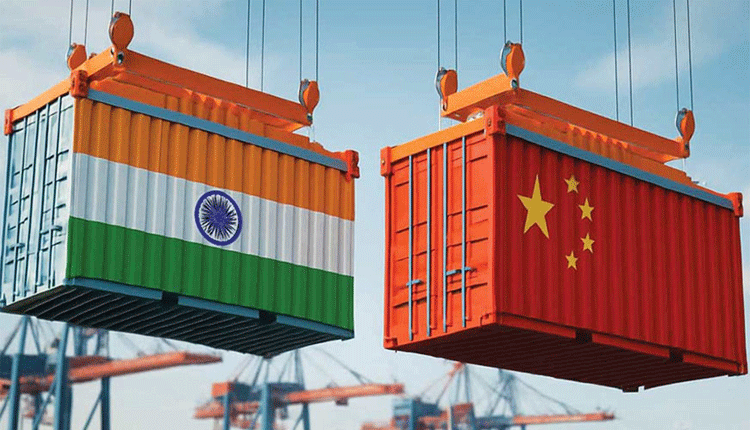
New Delhi: India is trailing China’s economic ascent by roughly 15 years but appears poised to follow a comparable growth path, according to an analysis by Alex Tabarrok, professor of economics at George Mason University.

Evaluating World Bank data, Tabarrok pointed out that India’s per capita Gross Domestic Product adjusted for Purchasing Power Parity (PPP) will touch $10,039 in 2025. This figure is nearly five times its 1990 level and places the country on par with China’s economic standing at the close of 2009.
The economist noted historical parallels between the two Asian giants, comparing Deng Xiaoping’s 1978 economic opening in China with the dismantling of the License Raj during India’s 1991 liberalization. The roughly 13 to 15 year gap between these seminal reforms continues to define the developmental lag between both nations.
While China built its economic dominance on large-scale manufacturing, export-led industrialization, and physical infrastructure, India has carved out a path centered on services, domestic consumption, and digital technology. China’s per capita GDP (PPP) is projected to reach $25,067 in 2025, which is about 2.5 times that of India. However, India currently outpaces China in speed, clocking a three-year annualized per capita growth rate of 6.3 percent against China’s 5.3 percent.
Tabarrok highlighted that a consistent 6 percent per capita growth rate doubles living standards every twelve years. He noted that if this trajectory persists for another decade and a half, India will become a middle-income country with a $20,000 per capita income, looking more like modern-day Brazil or Mexico than the India of Mother Teresa.
This momentum is already mirrored in broader social indicators. Under the World Bank’s $3-a-day benchmark, India’s extreme poverty rate dropped from 47.5 percent in 1993 to 27.1 percent in 2011, reaching 2.6 percent in 2023. Electricity access expanded from 60.3 percent in 2000 to 99.9 percent in 2024, while open defecation declined sharply from 73.2 percent to 6.7 percent. Furthermore, infant mortality has fallen by 72 percent since 1990, raising average life expectancy to 72.2 years.
Tabarrok cautioned that sustaining this progress will require pressing structural reforms. He observed that India still needs freer labor and land markets, cleaner air, faster courts, and greater state capacity to build robust manufacturing capabilities and create jobs.