

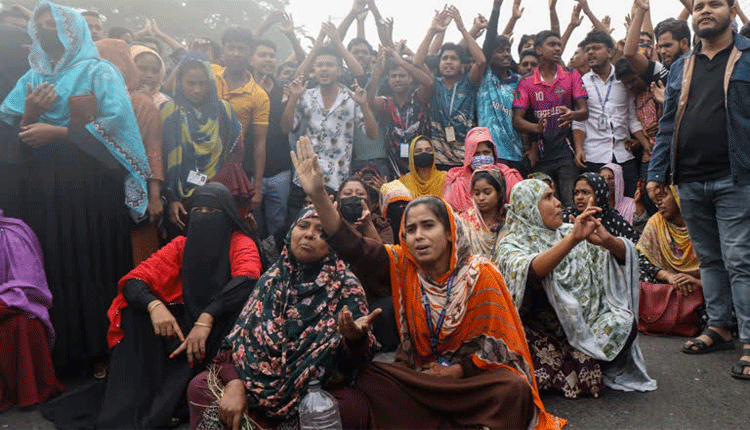
New Delhi: Following weeks of intense labour unrest, factory closures, and street demonstrations, Bangladesh has raised the minimum monthly wage for its ready-made garment workers by approximately 36 percent. A government-appointed wage board revised the entry-level salary from 12,500 taka to 17,000 taka (roughly $139 or ₹11,600), bringing partial relief to an export-dependent industry that accounts for over 80 percent of the country’s overseas earnings and employs more than four million people.

The revision, slated to take effect from 1 December with payouts starting in January, emerged from extended tripartite talks between factory owners, worker unions, and state officials. While trade unions had originally demanded an increase to 23,000 taka to counter sharp domestic inflation, workers’ representative Babul Akhter termed the decision a crucial, if incomplete, milestone. “Although we are not completely satisfied, the outcome is not entirely bad either,” Akhter stated, highlighting that the revision materialized in three years rather than the customary five-year cycle.
The developments in Dhaka offer three significant structural lessons for India’s domestic textile and apparel sector, which similarly employs millions of informal, low-wage workers:
First, sustained industrial competitiveness cannot rely permanently on compressed wages. While cheap labor initially drove Bangladesh’s ascent to become the world’s second-largest apparel exporter after China, prolonged suppression of wages amid rising living costs inevitably triggered social friction and costly disruptions. Industry experts note that long-term resilience requires investments in factory automation, worker upskilling, and supply chain speed rather than an unsustainable race to the bottom on labor rates.
Second, global fashion conglomerates must share the financial responsibility. Multi-national apparel brands demand low procurement costs while advertising ethical sourcing practices. However, leaving local manufacturers to absorb statutory wage hikes on razor-thin operating margins forces operational distress. Labour rights groups have urged international retail giants to reflect higher minimum wages in their purchasing prices.
Finally, the crisis underscores the importance of institutionalizing periodic, inflation-indexed wage reviews. For Indian textile hubs across Tamil Nadu, Gujarat, and Haryana, establishing formal social safety nets, humane working conditions, and regular wage revisions will prove vital to safeguarding labour stability as India seeks to expand its global apparel footprint.