

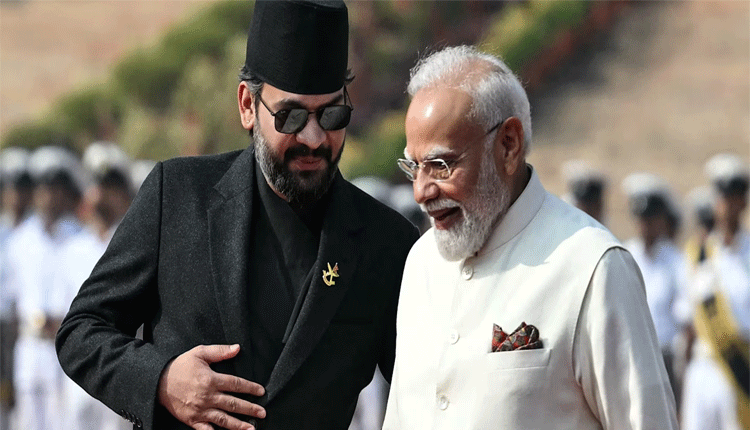
New Delhi: In a major push to deepen cross-border connectivity, energy security, and bilateral cooperation, Prime Minister Narendra Modi and Nepal’s Prime Minister Balen Shah concluded comprehensive bilateral discussions on Monday, unveiling a Rs 15,000-crore (NPR 24,000 crore) special development assistance package alongside eight key bilateral agreements.

The high-level engagement marked the culmination of Shah’s two-day official visit to India, resulting in a sweeping 19-point outcome charter outlined by the Ministry of External Affairs (MEA).
Strengthening people-to-people and spiritual ties under the Ramayana Circuit, both leaders virtually flagged off the ‘Saryu-Kamala Express’, a direct passenger train service linking Ayodhya in Uttar Pradesh with Janakpur in Nepal. The leaders also welcomed the completion of the field location survey for the proposed Raxaul-Kathmandu electrified broad-gauge railway line, operationalized a two-way air route along the Kathmandu-Bhairahawa-Lucknow corridor, and inaugurated a newly constructed motorable bridge connecting Dharchula in Uttarakhand with Darchula in western Nepal.
Cross-border energy integration featured prominently in the summit. The two Prime Ministers dedicated Phase 2 of the Motihari-Amlekhganj petroleum pipeline to the people of Nepal and laid the foundation stone for the 669-megawatt Lower Arun Hydroelectric Project. Additionally, foundation work commenced for a petroleum terminal at Jhapa, complemented by expedited plans for high-capacity power transmission corridors linking Inaruwa to Purnia and Dodhara to Bareilly.
On the educational and commercial front, both governments agreed to establish the first overseas campus of the Indian Institute of Technology (IIT) in Nepal to foster technical education and youth employment. To facilitate landlocked Nepal’s third-country transit trade, India granted expanded maritime access through Gujarat’s Deendayal Port at Kandla, with access to Odisha’s Paradip Port to follow once requisite logistical infrastructure is completed.
The eight Memorandums of Understanding (MoUs) signed cover forensic science collaboration, training for Nepali civil servants, traditional medicine, satellite communications via ISRO’s South Asia Satellite, and public health cooperation.
Reflecting on the summit’s success, Prime Minister Narendra Modi remarked on social media platform X: “These outcomes are diverse and far-reaching, reflecting the breadth of our ambitions, the strength of our collective resolve, and our unwavering commitment to shared progress. Significant momentum has been added to the India-Nepal friendship.”