

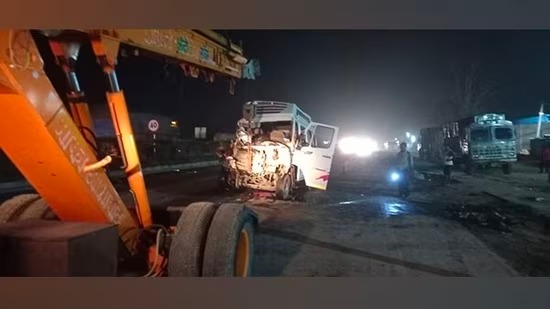
New Delhi: A devastating statistical reality underlies India’s transport network: an average of 20 people lose their lives every hour on the nation’s roads, translating to one death roughly every three minutes.

According to data compiled by the Ministry of Road Transport and Highways (MoRTH), a staggering 1,72,890 people were killed in road crashes across the country in 2023. The figures reflect a profound public health and infrastructure challenge that extends far beyond individual driver conduct.
A demographic breakdown of the fatalities dispels long-held assumptions about where and how road deaths occur. Vulnerable road users—those devoid of protective vehicular cabins—bore the overwhelming brunt of the casualties. Two-wheeler riders accounted for 44.8 per cent of all deaths, while pedestrians made up nearly 20 per cent. Men comprised approximately 85 per cent of the deceased, leaving thousands of families without their primary breadwinners. Tragic milestones were also recorded among younger populations, with 9,489 children losing their lives in crashes during the period.
Contrary to the common perception that urban gridlock and congested city junctions generate the highest toll, the geographical data points to rural stretches as the deadliest zones. Nearly 68 per cent of all road crash fatalities occurred in rural areas, where poorly divided state highways, unpaved shoulders, and unregulated mixing of fast trucks and slow-moving rural traffic create perilous driving conditions.
Among individual states, Uttar Pradesh logged the highest casualty count at 23,652 deaths, representing 13.7 per cent of the national aggregate. In contrast, major metropolitan centres recorded far smaller proportions; Delhi, despite recording the highest toll among cities, registered 1,457 fatalities—under one per cent of the total nationwide.
Excessive speeding remained the single most cited contributor, linked to 68.1 per cent of all fatal crashes.
However, road safety analysts point out that terming such occurrences mere “accidents” dangerously absolves broader systemic stakeholders of accountability. Road safety relies not only on driver behaviour, but on roadway engineering, prompt enforcement of safety norms, stringent vehicle roadworthiness checks, and swift emergency medical response within the golden hour. Under Article 21 of the Constitution, the fundamental right to life extends beyond household doorsteps onto public highways, necessitating comprehensive administrative intervention to arrest preventable vehicular fatalities.