

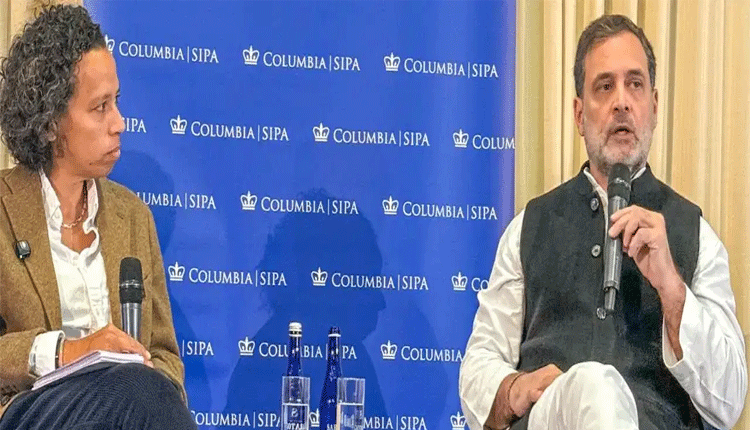
Chicago: Leader of the Opposition in the Lok Sabha, Rahul Gandhi, has advocated for a balanced approach to India’s foreign policy, supporting New Delhi’s defence ties with Israel while categorically condemning civilian casualties in both the October 7 terror attacks and the ongoing Israeli military offensive in Gaza.

Speaking at the University of Chicago in Illinois during an interactive session titled ‘The Iran War and India’s Role in the World’, the Congress MP shared his perspective on how India should navigate volatile West Asian geopolitics. Gandhi affirmed that maintaining bilateral cooperation and procuring defence equipment from Israel serves India’s strategic requirements, but asserted that India’s vast scale demands a foreign policy dictated strictly by its own national interests.
“We have a relationship with Israel; we have good relations. We buy weapons from Israel, and that is a good thing. But with all due respect, we are a much bigger country than Israel, with a population of 1.5 billion people,” Gandhi said. He emphasised that India’s diplomatic posture must remain sovereign and self-determined, noting: “Our foreign policy should be based on what is good for us, not on what is good for another country.”
Addressing the humanitarian crisis in West Asia, Gandhi condemned the cross-border strikes against Israel while equally censuring the scale of military destruction inflicted upon Palestinian civilians. “What happened in October was horrific and should never have taken place. Killing innocent people is absolutely unacceptable,” he said, referring to the October 2023 terror strikes. “However, I also condemn what Israel has done in Gaza. No one can condemn one wrong while ignoring the other.”
Beyond West Asian dynamics, Gandhi touched upon shifting global alignments, observing that the post-World War II international order dominated exclusively by the United States is rapidly giving way to a multipolar system. He remarked that future geopolitical stability will increasingly be shaped by multiple influential stakeholders, including India, China, Russia, and West Asian powers, urging India to engage with the world from a position of strategic autonomy.