

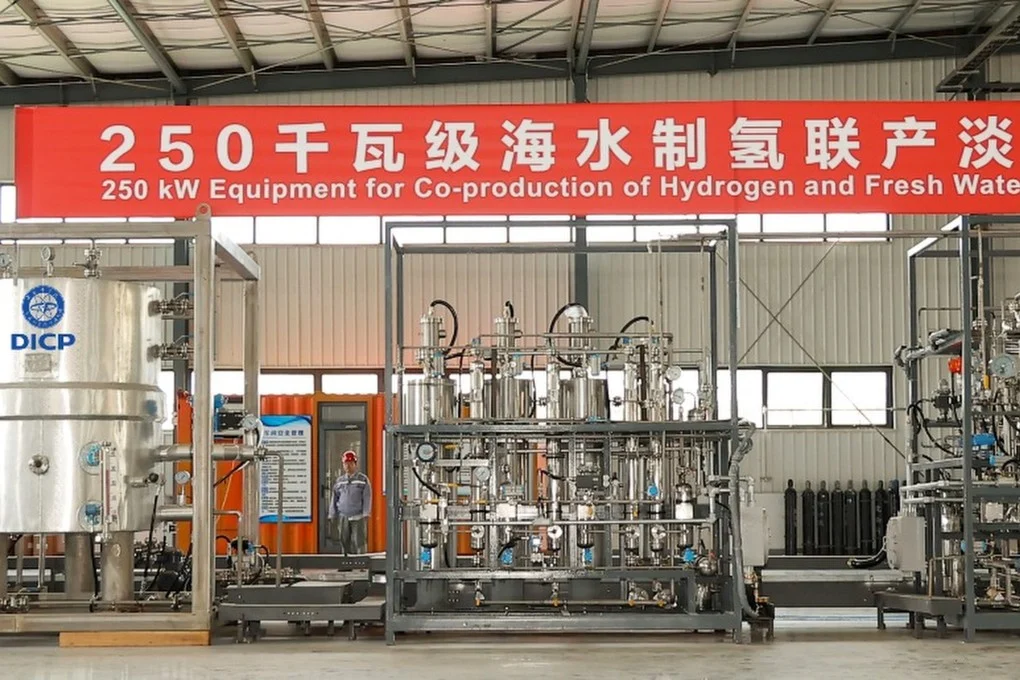
New Delhi: In a major breakthrough for green energy and resource recovery, Chinese researchers have developed a highly efficient system capable of simultaneously extracting hydrogen, fresh water, uranium, and bromine from seawater.

The innovative plant was designed by a research team led by Deng Dehui and Liu Yanting at the Dalian Institute of Chemical Physics, under the Chinese Academy of Sciences. The findings of this groundbreaking study were recently published in the prestigious journal ‘Nature Energy’.
Producing green hydrogen directly from seawater has historically been a challenge. Elements like chloride ions and magnesium can degrade electrodes and reduce the lifespan of the system. To counter this, conventional methods require a separate, energy-intensive desalination process before electrolysis.
The Chinese scientists solved this problem by seamlessly integrating the electrolyser with the desalination unit. The new system cleverly captures the “waste heat” generated during commercial electrolysis—which typically reaches 80 to 90 degrees Celsius—and redirects it to a vacuum distillation tower. This heat is then used to vaporise seawater at lower temperatures, producing enough fresh water to sustain the electrolysis process while generating a surplus for external use.
According to the research paper, the 250-kilowatt pilot plant can produce approximately 380,000 standard cubic meters of ultra-pure hydrogen (99.9999 percent) and 256 tonnes of fresh water annually. The integrated approach improved the system’s electrical efficiency by 14.4 percent compared to traditional alkaline water electrolysis.
Furthermore, the technology goes beyond just hydrogen and water. The highly concentrated brine left after desalination is processed to recover valuable marine resources in stages, including salt, bromine, and uranium. While the concentration of uranium in seawater is minute, the oceans hold a massive collective reserve, making this an exciting development for the future of nuclear fuel sourcing.
The system also promises significant cost reductions. The research team’s cost analysis suggests that if the plant is powered by onshore wind energy (at an estimated $0.033 per kilowatt-hour), the production cost of green hydrogen could drop to around $2.1 per kilogram. If powered by solar energy, it would cost approximately $2.9 per kilogram—both substantially lower than the current estimated price of $3.9 per kilogram.