

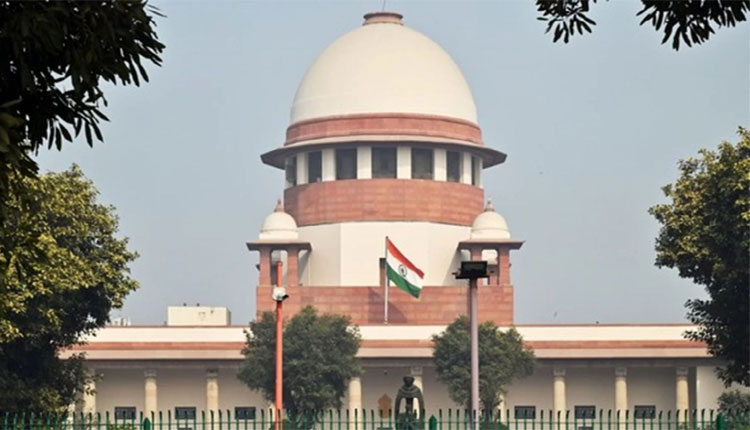
New Delhi: In a rare and emotional courtroom moment that transcended legal arguments, the Supreme Court of India imparted a stern moral lesson to a son embroiled in a bitter property dispute with his parents. While dismissing the son’s petition to claim ownership of his parents’ house, the apex court advised him to let go of the legal battle, touch his mother’s feet, and seek her forgiveness for his actions.

The case was heard by a Supreme Court bench comprising Justice Satish Chandra Sharma and Justice N.K. Singh. Dismissing the son’s Special Leave Petition, Justice Sharma remarked, “You should go and touch your mother’s feet and apologise. Apologise for all your sins.” Turning to the lawyers present in the courtroom, the judge added, “Isn’t it wrong for the son to do this? We are asking the son to go back to his mother, touch her, understand her feelings, apologise, and seek her blessings.”
The legal conflict centered around a residential property owned entirely by the mother and her husband. According to the case details, the parents had affectionately allowed their son and his wife to live on the first floor of their house as rent-free licensees. However, relations soon soured. The parents alleged that the couple began harassing them, relentlessly pressuring them to transfer the property into their names.
The situation escalated when the son and his wife allegedly attempted to claim ownership of the house using forged documents. Angered by the constant harassment and deceit, the elderly parents published a public notice in a local newspaper, formally severing all ties with their son and daughter-in-law. They also filed an FIR against the couple and issued a legal notice cancelling their permission to stay on the property.
When the son refused to vacate, the parents approached the trial court seeking possession of the first floor, a permanent injunction, and damages. The trial court ruled firmly in favour of the parents, noting that they were the absolute owners of the property and that the son was merely a licensee whose license had been rightfully revoked.
The son challenged the eviction order in the Delhi High Court, which upheld the trial court’s decision on April 17. Refusing to back down, the son appealed to the Supreme Court. The top court not only dismissed his plea but also delivered a profound reminder about familial duties and respect, closing the legal chapter of the dispute with a strong moral directive.