

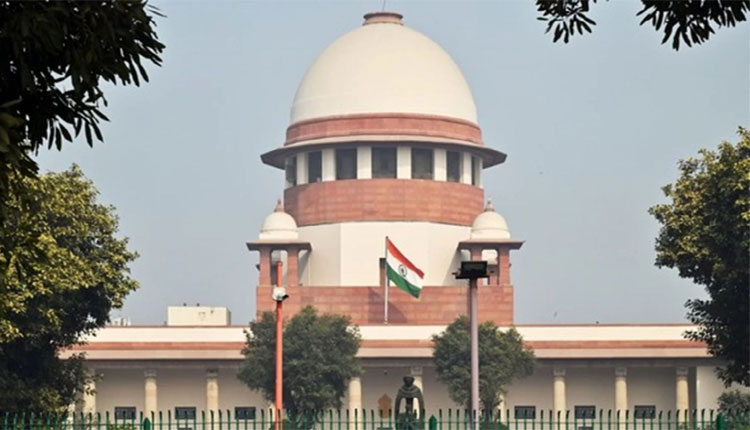
New Delhi: The Supreme Court of India has agreed to examine a critical and evolving legal question: whether Section 498A of the Indian Penal Code — the provision criminalising cruelty and dowry harassment by a husband or his relatives — can be applied to couples in live-in relationships, where no formal marriage exists.

In a recent hearing, a bench comprising Justices Sanjay Karol and N Kotiswar Singh observed that the statutory language of Section 498A (and related dowry laws) explicitly refers to “husband” and “wife.” This raises a fundamental issue: can a live-in partnership be legally equated to a marriage for the purposes of invoking these protections?
The case originates from a petition filed by Dr Lokesh B H, a cardiologist from Shivamogga, Karnataka, along with three family members. They challenge proceedings initiated against them under Section 498A following a complaint by a woman with whom the petitioner shared a live-in relationship (but no legal marriage). The Karnataka High Court had earlier declined to quash the case, prompting the appeal to the apex court.
Petitioners contend that the complainant is not a legal wife, and the FIR amounts to harassment. The Supreme Court, noting divergent rulings across various High Courts, has issued notices to the Union Ministry of Law and Justice and the Karnataka government. It has also appointed senior advocate Nina Nariman as amicus curiae to provide expert assistance.
High Courts have delivered conflicting views in the past: some extend Section 498A to live-in arrangements resembling marriage (especially where the woman was induced to believe the relationship was serious and marriage-like), while others strictly limit it to legally valid unions.
This matter highlights the tension between protecting vulnerable partners in non-marital cohabitation and preventing misuse of anti-dowry laws. The Supreme Court will deliver clarity on this nuanced intersection of evolving personal relationships and criminal liability.
The next hearing is scheduled for March 9.
Comments are closed.