

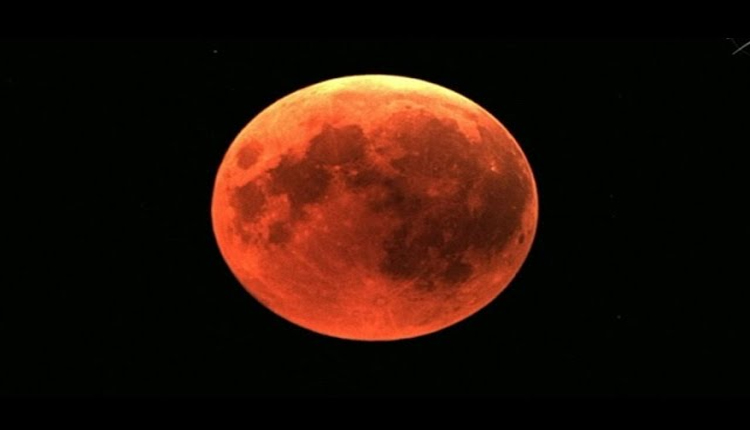
New Delhi: The night sky often gifts us breathtaking wonders, and few are as mesmerising as the Blood Moon — a phenomenon where the full moon has a deep red, coppery, or orangish hue during a total lunar eclipse.

Far from any supernatural lore, this celestial drama unfolds due to a clever interplay of sunlight, Earth’s atmosphere, and basic physics.
A total lunar eclipse occurs when Earth positions itself directly between the Sun and the Moon, casting its shadow over the lunar surface. One might expect the Moon to vanish into darkness, but instead, it glows eerily red. The secret lies in the Sun’s rays, which appear white but comprise a spectrum of seven colours. As these rays graze Earth’s edges and pass through our atmosphere, shorter wavelengths like blue and violet scatter away — a process known as Rayleigh scattering, the same that makes our daytime sky blue.
Longer wavelengths, such as red and orange, travel more efficiently through the air, dodging molecules with ease. Earth’s atmosphere acts like a giant prism, bending and redirecting this reddish light towards the Moon. Thus, the lunar surface reflects only these filtered hues, creating the striking Blood Moon effect.
Not all Blood Moons are identical; their shade varies from vibrant orange to a brooding crimson or even brownish, depending on atmospheric conditions. Dust from volcanic eruptions, smoke from wildfires, or urban pollution can intensify the filtering, making the Moon appear darker and more blood-like.
This natural spectacle reminds us of our planet’s dynamic role in the cosmos, turning a simple alignment into a fiery display. Skygazers, mark your calendars for the next eclipse to witness this atmospheric artistry firsthand.
Comments are closed.