

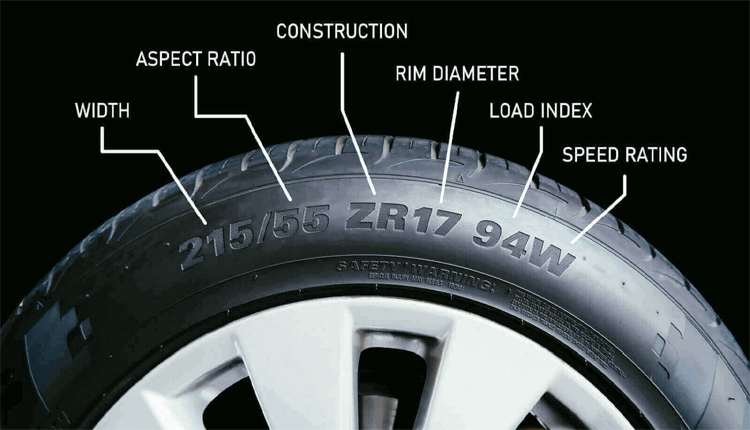
Your car’s tires may look like simple round rubber, but the letters printed on their sides— from A to Z— carry vital safety information that could save lives.

Those small alphabets, such as “L”, “T”, or “Y”, stamped on the tyre’s sidewall are not random codes. They represent the speed rating — the maximum speed a tire can safely sustain. In essence, your car’s safety, stability, and performance depend heavily on these letters.
For instance, a tire reading 205/55R16 91Y can handle speeds up to 300 km/h, while another labelled 175/65R15 84T is suitable for only 190 km/h. Each tire undergoes rigorous testing to determine how much heat and pressure it can handle at high speeds — a crucial factor in reducing blowouts and maintaining control on the road.
Ignoring these markings can be costly. Mixing tires with different speed ratings, such as fitting a “V”-rated tire alongside three “W”-rated tires, can affect the vehicle’s grip, comfort, and stability. Vehicle manuals usually mention the recommended tire rating — a guideline motorists should never overlook.
Here’s what the codes mean:
L = 120 km/h (light trucks, off-road vehicles)
T = 190 km/h (family sedans)
H = 210 km/h (sports sedans)
V = 240 km/h (sports cars)
Y = 300 km/h (high-performance cars)
So before hitting the highway, don’t just check your fuel gauge or mirrors — take a glance at your tyres too. That small letter might just keep you safe.
Comments are closed.